Impact Hypotheses


origin of the methodology
I was a Post Doc with C.J Walter and C.S. Holling in the early 70’s and thus participated in the development of Adaptive Environmental Assessment and Management (AEAM) which has subsequently been refined commensurate with both experience and the expansion of computer technology and programming expertise. This field is now known as Adaptive Management, and I think its most significant current domain of practice is represented by the Resilience Alliance.
In the 70’s and 80’s we conducted AEAM workshops in which we formulated a systems model for some ecological/social problem. Eventually it became clear that a complex system was more than most participants could describe or understand in a manner acceptable to all, and programmable by the staff, during a short (3-5 day) workshop.
Instead we developed an approach that consisted of linking specified activities to the indicators that people were concerned with in the form of Impact Hypotheses. This enabled individuals to focus on those areas for which they had expertise; and the workshop staff could piece together the elements as a whole system model after the workshop. We would often organize a second workshop in which the cross linkages between the hypotheses was discussed.
One of the main benefits of the approach turned out to be the clarification of what was known and what was not known; in other words the development of research priorities. Furthermore, sensitivity testing enabled us to determine which relationships were most critical to the eventual outcome. Sometimes simple logic within the explication of a network of relationships was as useful as sensitivity testing.
The approach is still used, though it is no longer always referred to as “Impact Hypotheses” – fashions change.
For example I have noted some references to “cause-effect networks” that to me appear to be basically the same.
what is “an impact hypothesis”?
An Impact Hypothesis describes how a human activity (Impact) influences an indicator, usually some Valued Ecosystem Component (VEC). The description is presented in terms of a network diagram of direct influences. This makes “arm waving” discourse or argument about indirect influences less likely, and enables actual quantitative study of the direct influences.
For most developments, eg. a dam or other alteration to river flow, one would normally develop a series of impact hypotheses as one action may affect many VEC’s or many actions may affect the same VEC. Some practitioners insist on one action/one VEC for each impact hypothesis. The separation of individual impacts makes discussion easier, while a consideration of alternative strategies for control or mitigation usually requires a joint consideration of several impacts.
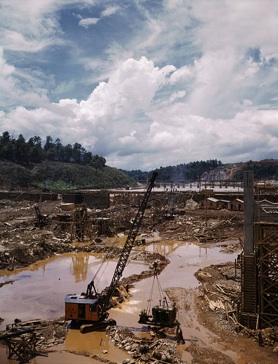
Douglas Dam, Wikimedia Commons
usefulness of the approach
In my view the main utility of using an impact hypothesis is the discipline of thinking in terms of direct effects v/s indirect effects. The chaining together of direct effects results in a influence diagram. This enables you to distinguish a portion of a dynamic system, the “boundaries” of which are your concerns and your expertise. As is always the case, this diagram is a simplification, you may leave some things out intentionally, and others are just not known to you. You can can evaluate the relative significance of those influences you have considered, and begin to see cross-linkages.

S.Kneebone in Ison, Systems Practice

abstracting a chain from a net
As indicated in the drawing, usually there are several activities or actions taking place concurrently, and there is usually more than one VEC being influenced. The trick to formulating a single Impact Hypothesis is to limit the consideration to only those links that follow as direct influences from a given activity leading to a given VEC.
In the original formulation of impact hypotheses the actions were always put on the bottom of the figure, and the VEC’s at the top. This conveys a sense of influences percolating up to that which matters – but it is only a convention.
Impact hypotheses do not usually incorporate feedback loops. There is no formal reason they should be excluded, but the focus is on looking at a chain of influences that derives from a specific human action – and this concern confers a directionality.
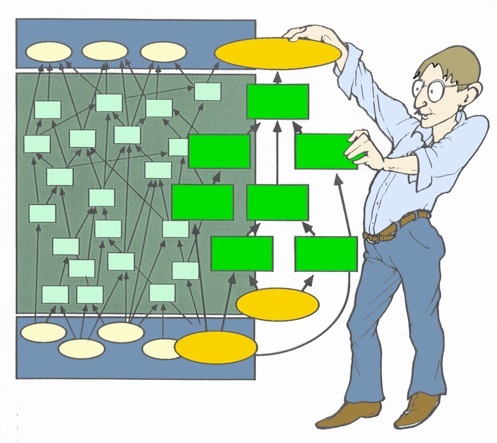
activity
valued component


example
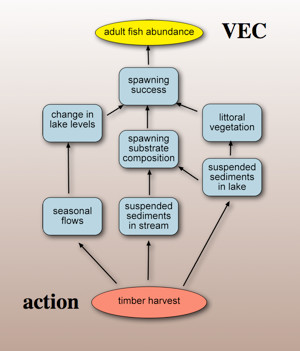
For a lake spawning fish, the concern was that logging would influence its abundance. This diagram was proposed in a workshop by the managers and researchers involved. This was only one of a series of impact hypotheses developed for the particular set of concerns around expansion of logging in the area. For example another impact hypothesis considered the activity of road building, which also affected suspended sediments in both streams and lakes.
from connection to relationship
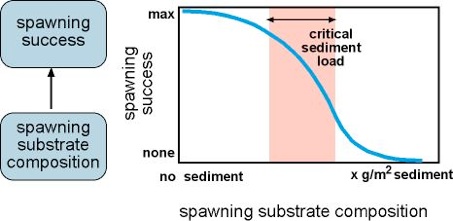
Impact hypotheses require that all connections are shown as direct effects rather than subsuming many steps or indirect effects in one arrow. Indirect effects obscure many intermediary steps and are not easily evaluated.
Each arrow in the impact hypothesis diagram can be represented graphically as the relationship between the variables at each end of the arrow. For each connection, the arrow starts from the independent variable, and points to the dependent variable. Thus the form of the connection can be shown on a graph with the x axis representing the box that the arrow starts from, and the y axis the box that the arrow points to.
All the possible forms of relationship mentioned on the page relations among elements are possible. The process for plotting them is to begin with a basic understanding of what makes sense, and then if appropriate find data or do research to articulate and validate the initial hypothesis.
Impact Hypothesis diagrams are thus a collection of hypotheses concerning relationships that can be logically strung together, validated, and evaluated.
salmon photos Larry Hildebrand