resilience

resilience
The notion of resilience as the “power of recovery” was first coined in the 1850’s. This is clearly a useful notion, and consequently it has been applied to many aspects of human concern. Although it is a very evocative and useful notion, it is also somewhat slippery of being defined precisely.
It is difficult to specify what exactly a “recovered” condition consists of,what it is presumed to be recovering from, and how fast it should recover in order to qualify as “resilient”. This is especially true for complex, adaptive and evolving systems that have no clear boundaries -- for example ecosystems.
P. Bunnell with J. Wolsak
for the Stockholm Environmental Institute


attitude matters
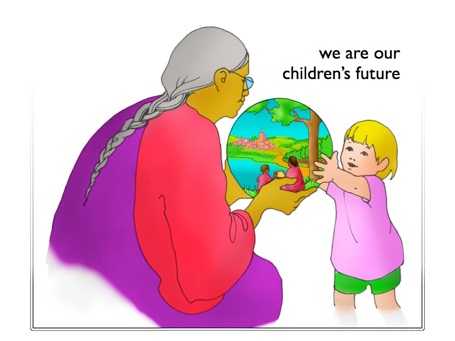
When we face a situation that appears complex or confusing, we may respond in many different ways. Rather than enumerating these, I would like to point to the underlying emotions. If our emotion, or attitude, is one of despair, or unwillingness to engage, we have essentially chosen to be irresponsible, to let change happen to us, regardless of what we may claim we are doing or thinking. However, with hope and optimism we do engage.
Though we cannot determine what happens, we can usually influence the change.
If we ourselves remain resilient, it is much more likely that
our actions will result in a resilient system.
S. Kneebone: image on left not published, the one on the right in Ison, Systems Practice

ecosystem resilience
“Ecosystem resilience is the capacity of an ecosystem to tolerate disturbance without collapsing into a qualitatively different state that is controlled by a different set of processes. A resilient ecosystem can withstand shocks and rebuild itself when necessary. Resilience in social systems has the added capacity of humans to anticipate and plan for the future. Humans are part of the natural world. We depend on ecological systems for our survival and we continuously impact the ecosystems in which we live from the local to global scale. Resilience is a property of these linked social-ecological systems (SES). "Resilience" as applied to ecosystems, or to integrated systems of people and the natural environment, has three defining characteristics:
the Resilience Alliance
The Resilience Alliance was founded in 1999 by a group of scientists inspired by Buzz Holling who remains as the Founding Director. It is now an international network of member organizations interested in the dynamics of how social and ecological systems interact. The people who work within this group are interested in the understanding not only resilience, but also adaptability and transformability, both of which are highly relevant to our human concerns of sustainability.
The organization operates in collaboration and provides open access to its extensive body of work as well as an excellent bibliography.
Anyone seriously interested in ecosystems and sustainability will find
the RA website extremely useful.

-
•The amount of change the system can undergo and still retain the same controls on function and structure
-
•The degree to which the system is capable of
self-organization -
•The ability to build and increase the capacity for learning and adaptation”





resilient or robust
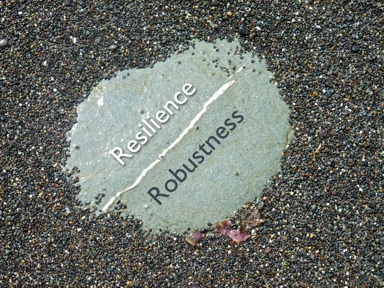
In order for a system to persist under conditions of change, it must either be strong enough or robust enough, not be be influenced or perturbed by the change, or if it bends to the change, it needs to be able to return to its previous state through its own internal processes. In the latter case we consider it to be resilient.
Systems also change over time, they adapt and evolve.Thus we need to consider whether the changes that we think are taking place change the system into something else or whether they are simply within the range of variability for that sort of system. Often this judgement is a matter of what we prefer in terms of the qualities of the system as we see it.