EECO 504
Introduction to Systems Methods
What is a system?
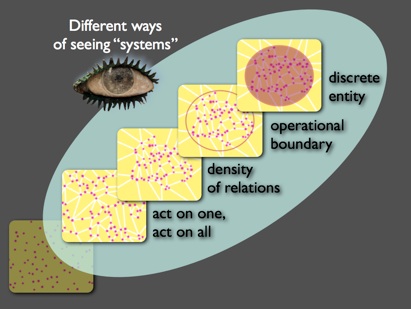
There are many definitions of “system” See for example the online dictionary. There at the top of the list you find “A group of interacting, interrelated, or interdependent elements forming a complex whole” but there are 8 others!. And there are many others proposed by people specifically engaged in Systems Studies (see box).
Which one is appropriate for us to consider? And in what context?
working with systems
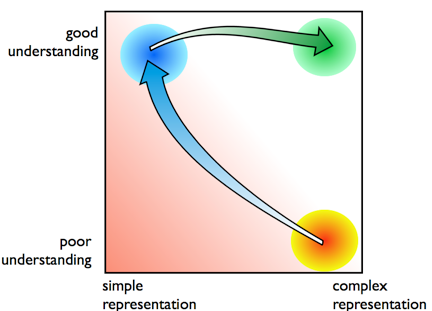
In the 1980’s Dr. C.S. Holling offered a useful insight that still pervades my thinking. We were building ecosystem models for management at the time, and he suggested that there is always a process involved in us coming to grips with a complex system. If we start with a complex representation of a system, we cannot understand it. If we wish to understand, we must first simplify, and from there slowly grow our understanding.

a set of variables selected by an observer.
(Ashby)
a set or arrangement of entities so related or connected so as to form a unity or organic whole.
(Iberall)
“the purpose of a system is what it does”
(Beer)
There are many things to consider
when we think about naming something a system:
-
•systems can arise spontaneously, of if human-made,the can be designed
-
•systems are conserved as long as the operational coherences that lead to their existence persist
-
•living systems generate and conserve themselves
-
•what we perceive as “a system” is governed by our biology, language and culture
-
•how we operationally interact within our own complex existence is partly guided by our conceptions of that system
-
•no one has a privileged access to a universal “Reality”, yet we can and do coexist in many lived realities
many methods, many perspectives
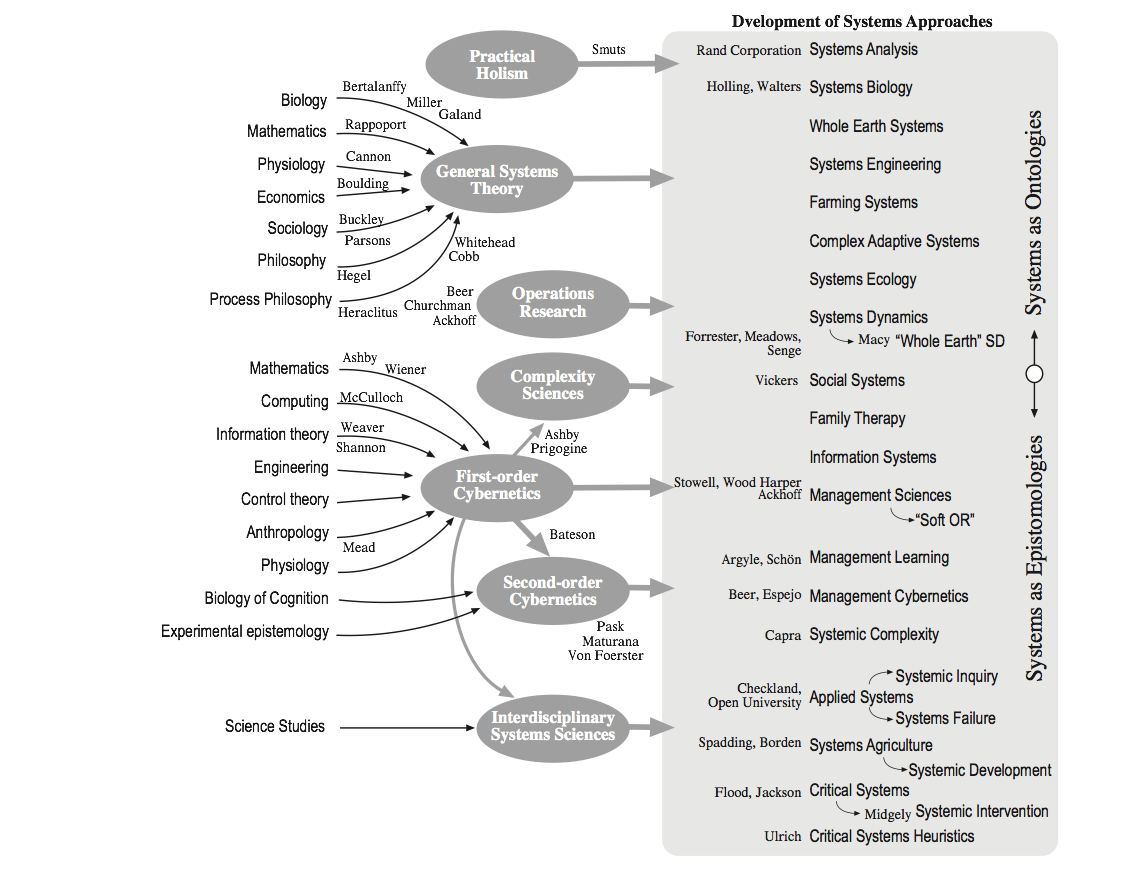
I worked with Ray Ison as he wrote and published his recent book Systems Practice: How to Act in a Climate-Changed World” (Springer, 2010). One of the interesting tasks Ray undertook is the creating a graphic overview of the development of systems approaches. You will notice that they are vertically arrayed with ontologies on top (studies about what “is”) and epistemologies (how we know what we know) below. This array is not strict, as many methods have a mixed or ambiguous perspective. Hence this is a loose set of categories.
I have outlined the names of authors directly referred to in this course in red.
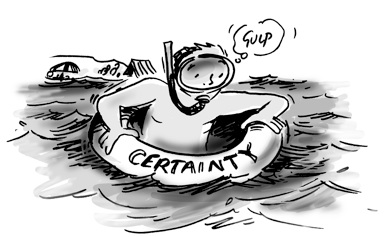
Simon Kneebone, draft figure
not used in Ison “Systemic Practice”
.oOo.


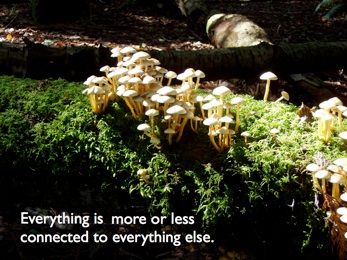

You may find a look through the OpenUniversity (UK) course “Systems Thinking and Practice” a useful adjunct to this course. This course was developed my Ray Ison and his colleagues at the OU.
(click on image)
Though we can live our lives embedded in the complex systems that comprise our human medium, in order to intentionally interact with these systems, based on language so that we can coordinate what we do, we must indeed simplify our representation.
Systems methods enable simplification.
No method is capable of representing the entire complexity of our existence. Indeed, I note that the only adequate model of our world is a duplicate world... and even that would soon drift a different way due to chaotic effects at micro levels that sometimes propagate in unpredictable ways.